
Boston is one of those cities that feels like it was built for a scavenger hunt. From cobblestone streets that date back to the colonial era to sprawling museums, every corner of the city holds a story waiting to be uncovered. It’s no wonder teams keep coming back.
Whether you’re organizing a city scavenger hunt for out-of-office bonding or simply want to explore Boston in the most engaging way possible, the city delivers on every front. The challenge isn’t finding interesting locations. It’s choosing which ones to visit first.
To help you plan, we’ve pulled together 10 of the best places to explore on a scavenger hunt in Boston. All of these locations are within a manageable distance of one another, making it easy to jump between stops without burning half your day in transit.
1. cityHUNT Boston Scavenger Hunt

Before diving into the individual locations, there’s one option that takes the work entirely off your plate. cityHUNT offers corporate team-building scavenger hunts for professionals across Boston.
You’ll get highly interactive experiences designed to spark curiosity, encourage exploration, and bring teams closer together. Every hunt is tailored to the specific group, so your team gets an experience unlike any other.
As one of America’s oldest cities, Boston is known for its rich history and booming culture of sports and entertainment, and cityHUNT’s scavenger hunts are designed to let teams experience all of it.
Whether you want to explore a specific neighborhood or roam across the city’s most iconic landmarks, every cityHUNT scavenger hunt is a fully custom experience. And if you want to explore a certain area of Boston, they can accommodate that.
Most hunts run between 1.5 and 2 hours, though customized experiences can be as short as 1 hour or as long as 48 hours.
Pricing depends on the level of customization and on-site support. For workplace scavenger hunt planning, cityHUNT recommends booking at least two to three weeks in advance.
2. The Freedom Trail

If there’s a single experience that defines Boston for first-time visitors, it’s the Freedom Trail, and for a corporate scavenger hunt, it’s practically purpose-built.
The Freedom Trail is a 2.5-mile path through Boston that passes by 16 locations significant to the history of the United States, winding from Boston Common through the North End to the Bunker Hill Monument and USS Constitution in Charlestown.
The trail connects 16 historical sites and attracts more than 4 million visitors annually. Stops range from simple ground markers to graveyards, churches, and a historic naval frigate. This should give your team an enormous amount of clues across a single walkable route.
For a corporate scavenger hunt, the Freedom Trail offers an ideal structure. Teams can be sent to specific sites with riddles to solve or photo challenges to complete at each stop.
Here are some scavenger hunt ideas to try along the trail:
- Find the weather vane on top of Faneuil Hall and describe what shape it is, and why it was used to identify spies during the Revolution.
- Locate a gravestone at the Granary Burying Ground belonging to one of the Boston Massacre victims.
- Stand at the exact spot where the Declaration of Independence was first read aloud to Bostonians and document the building you’re outside.
- Find the lantern signal location at the Old North Church and describe what Paul Revere’s signal meant.
Most of the sites are free or suggest donations, though the Old South Meeting House, the Old State House, and the Paul Revere House charge admission. Plan to spend two to four hours here, depending on how deeply your team explores each stop.
3. Faneuil Hall and Quincy Market

Few places in Boston are as electric as Faneuil Hall and Quincy Market, and few are as layered with hidden history that makes for exceptional scavenger hunt material.
Opened in 1742, Faneuil Hall was designed as a marketplace and meeting hall, and is sometimes referred to as the “Cradle of Liberty” for the many speeches and debates that took place there over its history.
The marketplace is made up of Faneuil Hall, Quincy Market, North Market, and South Market, all set around a cobblestone promenade. That spot is where jugglers, magicians, and musicians entertain the crowds.
It draws over 18 million visitors annually and remains one of the most visited tourist destinations in Boston.
The grasshopper weather vane on top of Faneuil Hall is one of Boston’s most iconic but least-noticed details.
The weather vane was considered so well-known to Boston citizens that during the Revolution, local legend says suspected spies were asked to identify the weather vane and if a suspected spy could not identify it, they could be convicted. That’s the kind of fact that makes for a perfect scavenger hunt question.
Other ideas for your team-building scavenger hunt:
- Find and photograph the Samuel Adams bronze statue near the entrance. Which famous sculptor created it?
- Track down a pushcart vendor selling something uniquely Boston and document what it is.
- Locate the National Park Service visitor center inside the Hall and find out what year Faneuil Hall was first used as a meeting room (hint: it wasn’t 1742).
- Head to the upper floor and document the large painting in the Great Hall.
Street performers, food vendors, and a cobblestone atmosphere make this one of the most memorable stops on any city scavenger hunt in Boston.
4. Boston Common and the Public Garden
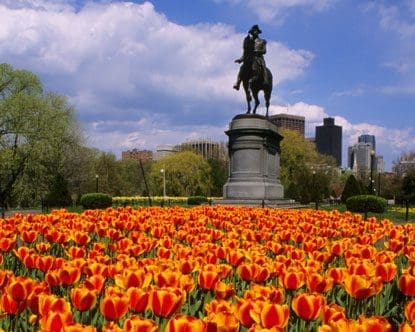
Boston Common holds a distinction that’s worth knowing before you arrive: it’s the oldest public park in America, founded in 1634, a 50-acre green space in downtown Boston at the starting point of the Freedom Trail.
British troops once used it as a training field. Today, it hosts concerts, ice skating rinks, and public events that fill the space year-round.
Adjacent to Boston Common sits the Boston Public Garden, America’s first public botanical garden, with its famous Swan Boats, weeping willows, and the beloved “Make Way for Ducklings” sculptures.
The two spaces together form one of the most photographed and recognizable outdoor environments in New England.
For a workplace scavenger hunt, the Common and the Public Garden are an ideal starting point. The open space makes it easy to rally teams, go through the rules, and send groups off in different directions.
Scavenger hunt ideas include:
- Find the Edgar Allan Poe Square at the southwest corner near the Common. Can you describe what the sculpture depicts?
- Locate the Parkman Bandstand and find out what public events it’s historically hosted.
- Take a group photo imitating the pose of the “Make Way for Ducklings” duck family near the lagoon.
- Challenge teams to find a landmark in the park that isn’t on any visitor map.
Both spaces are free to enter and accessible year-round, making them a reliable cornerstone of any team-building activities scavenger hunt in Boston.
5. The Museum of Fine Arts Boston (MFA)

When it comes to indoor scavenger hunts in Boston, the Museum of Fine Arts is in a league of its own. The MFA contains more than 450,000 works of art, making it one of the most comprehensive collections in the Americas, and draws over 1.2 million visitors a year.
Founded in 1870, the museum spans thousands of years of human history and covers everything from ancient Egypt to contemporary American art.
Some of the museum’s most famous works include paintings by Vincent van Gogh, Rembrandt, John Singer Sargent, Winslow Homer, and Claude Monet.
Alongside these gems, there are significant collections of Egyptian artifacts, ancient Greek and Roman art, Asian art, and Islamic art.
With dozens of galleries and multiple floors, teams can spend the entire afternoon without retracing a single step.
Notable works to build scavenger hunt clues around include John Singleton Copley’s portrait of Paul Revere, Gilbert Stuart’s unfinished portrait of George Washington, and the impressive Dale Chihuly glass sculpture in the glass-enclosed courtyard.
Scavenger hunt ideas for teams:
- Find the oldest artifact on display in the Egyptian collection and write down what it is and its approximate age.
- Locate a portrait where the subject is holding a book or object and identify the artist.
- Find a painting with an animal hidden somewhere in the background.
- Mimic the pose of a sculpture somewhere in the museum and photograph the result.
Since the MFA is so large, keep each team’s hunt within a defined wing or floor to prevent the experience from becoming overwhelming. Admission is required, and the museum offers group rates for larger corporate events.
6. New England Aquarium

Located on Boston’s waterfront at Central Wharf, the New England Aquarium is one of the most distinctive scavenger hunt locations in the city, and one where no two visits feel the same.
The aquarium’s main attraction is the Giant Ocean Tank. It’s a 200,000-gallon cylindrical exhibit that simulates a Caribbean coral reef, surrounded by a spiral walkway with 60+ acrylic windows that allow guests to view it from every angle.
The permanent residents of the tank include Myrtle, the green sea turtle, who has lived in the Giant Ocean Tank since 1970 and is still there today.
The aquarium is also home to African penguins, California sea lions, reef-dwelling sharks, moray eels, and thousands of tropical fish across multiple exhibits.
For a team-building scavenger hunt, the New England Aquarium gives teams something most Boston locations can’t: the chance to search for specific animals by description and compete to find them first. Ideas include:
- Find Myrtle the sea turtle on the spiral walkway and document which floor she’s visible from.
- Take a selfie next to the animal you find most surprising, with bonus points for a creative caption.
- Look for an animal that matches the description: “lives in the deep, has no backbone, and can change color.”
- Find the shark and ray touch tank and describe what it feels like.
The aquarium is also home to over 750 animal species across four levels of exhibits. Plan for at least two hours here, and consider adding an IMAX film for teams that want to extend the experience after the hunt.
7. Beacon Hill

If Boston has a neighborhood that looks like a film set from another century, it’s Beacon Hill. Gas-lit streets, Federal-style brick townhouses, narrow cobblestone lanes, and window boxes in full bloom make it one of the most visually striking neighborhoods in New England.
At the top of the hill sits the Massachusetts State House, its golden dome gleaming over the city. Designed by Charles Bulfinch and built in 1798, the State House remains the seat of the state’s government.
It features intricate murals, historic rooms, and echoes of legislation that once challenged British authority. Entry is free and open to the public.
Wander down from the State House into the residential streets of Beacon Hill for some of the best hidden-detail scavenger hunt moments in the city:
- Find the narrowest street in Beacon Hill and photograph the entire group standing side by side across its width.
- Locate a historic plaque on Acorn Street — one of the most photographed cobblestone lanes in the U.S. — and document what it says.
- Find an original gas lamp still lit on a residential street and identify which block it’s on.
- Challenge teams to find the Nichols House Museum and document the approximate year of its construction.
Beacon Hill is best explored on foot, and its compact layout makes it ideal for a team-building scavenger hunt for office groups of any size.
8. Harvard Square and Harvard University

Just a short ride across the Charles River on the MBTA Red Line, Harvard Square is a world unto itself.
Harvard University was founded in 1636 and is the oldest institution of higher learning in the United States. Its campus, all leafy paths, red-brick buildings, and centuries of academic tradition, is free to enter and open to visitors year-round.
Harvard Yard is the heart of the campus, home to the John Harvard statue, the Widener Library, and the famous “Statue of Three Lies” (the inscription is wrong in three separate ways, a great trivia challenge for any scavenger hunt team).
The surrounding Harvard Square neighborhood adds indie bookstores, international restaurants, and a lively street performer scene that gives teams plenty to explore between clues.
Scavenger hunt ideas for Harvard Square and campus:
- Find the three inaccuracies on the John Harvard statue plaque and document all three.
- Photograph the team in front of the Widener Library and find out how many steps lead up to its entrance.
- Challenge each team to find a Cambridge-based historical fact they didn’t know before the hunt and present it at the end.
- Locate a building on campus named after a U.S. president and document which one.
For a corporate scavenger hunt that wants a mix of culture, history, and fresh air, Harvard Square delivers an experience that feels distinctly Bostonian.
9. The North End

Boston’s North End is the oldest residential neighborhood in the city, and one of the most sensory-rich environments for a scavenger hunt.
This is where Italian immigrants shaped the character of an entire district, and where their descendants still run the family bakeries, trattorias, and salumerias. These shops actually make the neighborhood one of Boston’s most beloved food destinations.
The North End is also home to some of the most historically significant sites on the Freedom Trail, including the Paul Revere House and the Old North Church.
The Paul Revere House, built around 1680, is the oldest remaining structure in downtown Boston and the only official Freedom Trail historic site that is a home.
The Old North Church, built in 1723, is best known for the midnight ride of Paul Revere and the famous signal “one if by land, two if by sea.”
For a scavenger hunt for office teams, the North End is ideal because it combines historic landmarks with a lively, food-forward street culture that gives teams natural gathering points between challenges. Ideas include:
- Find the Old North Church steeple and recreate the lantern signal with two team members holding imaginary lanterns.
- Locate the Copp’s Hill Burying Ground and find the oldest legible gravestone, then document the name and year.
- Stop at a pastry shop on Hanover Street and challenge teams to order something without pointing at the menu.
- Identify the neighborhood’s most famous annual festival and explain its historical roots.
The North End is one of Boston’s most walkable neighborhoods and packs more history per square block than almost anywhere else in the city.
10. Isabella Stewart Gardner Museum

For a scavenger hunt location with a genuine mystery baked in, nothing in Boston compares to the Isabella Stewart Gardner Museum.
Housed in a Venetian-style palace, the museum features works by Rembrandt, Botticelli, and Sargent, with everything displayed in ornately decorated rooms that make visitors feel closely connected to the history of each piece.
But the Gardner’s most compelling feature is what’s missing from the wallls! In 1990, thieves disguised as police officers broke in and stole 13 works of art in what remains the largest art theft in history.
The empty frames still hang in the galleries where the paintings once were, a deliberate choice by the museum in anticipation of their return. The stolen works have never been recovered.
That backstory alone makes the Gardner a natural fit for a corporate scavenger hunt with a mystery theme. Ideas include:
- Find one of the empty frames where a stolen artwork once hung and document what piece was taken, who painted it, and its estimated value.
- Locate the central courtyard garden and identify a plant or flower species growing inside it.
- Challenge teams to find the room with the most natural light and explain how the museum’s architecture achieves it.
- Find a work by John Singer Sargent and describe the scene it depicts without naming the title.
The museum also hosts rotating contemporary exhibitions and live performances, making the experience feel fresh even for repeat visitors. Admission is required, and the museum recommends advance booking for groups.
Boston Scavenger Hunt Tips and Ideas
With locations as varied as the Freedom Trail and the Gardner Museum, Boston is a city that rewards planning. Here are a few tips to help your team-building activities scavenger hunt run smoothly:
Map Your Route Before the Day
Boston’s most compelling scavenger hunt locations cluster naturally into walkable zones: downtown (Faneuil Hall, the Freedom Trail, the Aquarium), the Back Bay (the MFA, the Public Garden), and the North End.
Plan which zones your hunt will cover and sequence your stops to minimize backtracking.
Mix History With Sensory Challenges
Boston’s biggest asset as a scavenger hunt city is the density of its history. Use that to your advantage by pairing trivia-style clues with photo challenges, physical tasks, and team decisions.
A hunt that asks teams to both answer a question and recreate a famous scene will keep energy levels higher across the full duration.
Think About Group Size When Choosing Locations
Larger indoor spaces like the MFA or the New England Aquarium can comfortably absorb teams of 50 or more without everyone crossing paths.
Tighter spaces like the North End or Beacon Hill work better for smaller groups who can spread out more naturally across the neighborhood streets.
Use the City’s History as Your Clue Source
Boston is one of America’s most historically layered cities, and that gives scavenger hunt designers an almost unlimited source of trivia, riddles, and landmarks to work with.
Build clues around events your team might vaguely know, like the Boston Tea Party, the midnight ride of Paul Revere, and the unsolved art heist at the Gardner. Let the hunt teach them something along the way.
Throw in a Finish-line Moment
Every great scavenger hunt ends with something to remember. Whether that’s a team dinner at a North End restaurant, clam chowder in a bread bowl at Quincy Market, or a post-hunt gathering at one of the city’s acclaimed breweries.
Give your teams something to look forward to at the finish. The debrief after a great hunt is where the real bonding happens.

Consider Going Professional
Planning and executing a corporate scavenger hunt in Boston takes real work. Sourcing locations, writing clues, managing logistics, and keeping large groups on track are all full-time challenges.
If you want the experience to feel polished and truly memorable, cityHUNT has spent over two decades refining exactly that.
They’ve designed and executed unforgettable team-building events for groups of hundreds to thousands. Plus, they work with you to determine the type of experience you’re looking for and come up with the best possible location in Boston.
Boston is a city that rewards curiosity, and there’s no better way to bring a team into that spirit than a well-designed scavenger hunt through its streets.
Whether you’re navigating the Freedom Trail for the first time or uncovering the hidden details of Beacon Hill’s gas-lit lanes, the city never runs out of surprises.


